Chapter 1: Impact
The late sun had turned the towers of Metro City amber by the time Alex Mercer cut through the crowds on Seventh, messenger bag knocking against his hip. Horns, sirens, the smell of hot tarmac and fryer oil. He barely noticed any of it any more.
He was an investigative journalist at The Metro Gazette, though "investigative" flattered the budget. His colleagues chased celebrity divorces and quarterly earnings. Alex chased planning committees, procurement contracts, the slow grey machinery of corruption. Stories that never sold papers and occasionally changed something.
The building where he rented his workspace was eight storeys of tired brick between a dry cleaner and a bail bondsman. Sam, the night guard, looked up from his crossword.
"Midnight oil again?"
"Stories don't wait for daylight."
"Neither does a heart attack. Get some sleep."
Upstairs, Alex spread the files across the table: clippings, redacted memos, three months of notes on a city contracts scandal that was almost, almost ready to break. He lost an hour to it without noticing.
The first tremor took his coffee off the table.
He stood, frowning at the brown puddle spreading across a memo, and felt the second through the soles of his shoes, a deep vibration, wrong in a way he couldn't name. The lights flickered. At the window, the sky had gone strange: clouds massing and turning, too dense, too fast. His phone buzzed against his thigh. EMERGENCY ALERT. SEVERE ANOMALY. SEEK SHELTER.
Then the sky tore open.
He saw it for perhaps two seconds, a line of white fire dragging smoke behind it, growing, and the animal part of his brain understood before the rest of him did.
The impact was not a sound. It was pressure, everywhere at once, and then the windows came in.
He was on the floor with glass in his hands and blood in his mouth. The building was moving in ways buildings should not move. He got up, got to the corridor, started shouting. Doors opened. Half a dozen people spilled out, white-faced, coughing in the dust.
"Emergency stairs! East end! Go!"
They went, and panic went with them: shoving, someone screaming a name. Another tremor brought a section of ceiling down ahead, sealing the corridor. Alex turned the group back toward the far stairwell, one hand on a stranger's shoulder, and they were ten feet short of the door when the floor stopped existing.
Darkness.
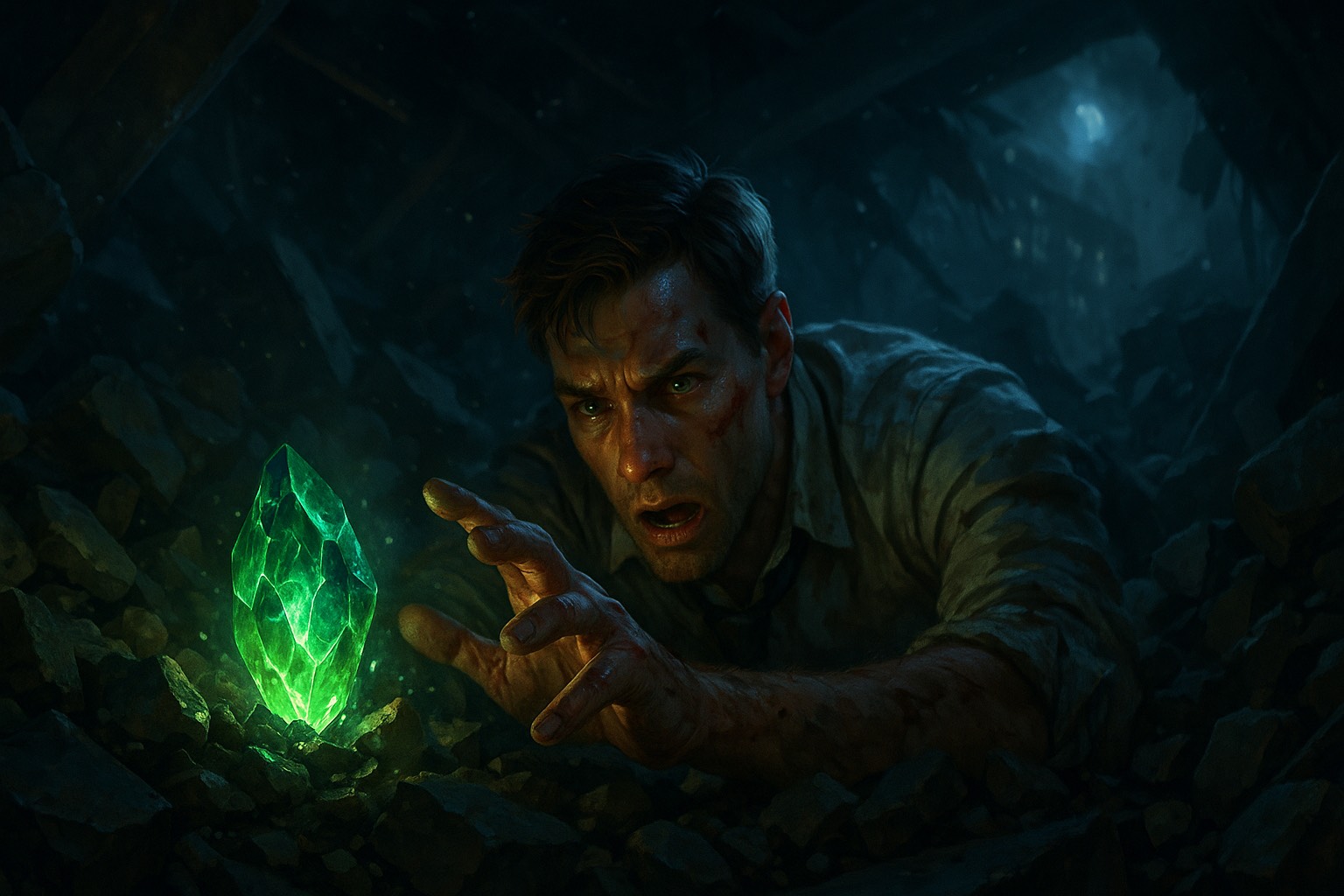
He couldn't say how long. There was weight on his chest, an enormous patient weight, and each breath was a negotiation. Concrete dust, and under it the copper taste of blood. He tried to move his legs and the pain that answered was so total it almost had a colour.
"Help." Barely a word.
Time went soft. He drifted, surfaced, drifted. At some point he was crying and couldn't get enough air to do it properly, which struck him, distantly, as the loneliest thing that had ever happened to him.
Stay awake. Someone will be looking.
His eyes adjusted, or thought they did. There was light down here. Not daylight. A pale green pulse, inches from his face: a shard of the meteor, crystalline, fractured, glowing from within like something alive.
He reached for it. He never afterwards understood why.
Contact, and the world went white. Energy poured into him through his fingers, up his arm, into his chest, every nerve firing at once. Images he didn't own tore through him: fire, falling, a sound like a choir dying. He couldn't scream. He couldn't breathe.
The crystal crumbled to powder between his fingers.
Then nothing.
Voices woke him. The scrape of tools on concrete, dogs, a man shouting measurements. Then hands, and weight lifting away, and air.
"He's alive! We've got a survivor!"
They carried him out under a full moon. Silver light lay on his face and something in him drank it, slowly, the way cracked earth takes the first rain. Not enough to heal him. Enough to keep him.
He woke to fluorescent light, the antiseptic smell, the beep of monitors. Plaster on both legs and one arm. A nurse leaned into his line of sight.
"You're awake. You've been through quite an ordeal."
"How long?"
"Five days. Three surgeries. Honestly, you're a miracle." She checked his chart. "Can you tell me your name?"
He looked at her and heard himself say, "I don't remember."
He didn't know yet why he lied. Only that some instinct, older than thought, told him to stay small.
"That's all right. It'll come back." She adjusted his pillows. "You said something about the meteor when they brought you in. Do you remember that?"
"Some of it."
"That's good. Rest now. Rest is the best thing."
But rest was the wrong word for what happened over the following days. He healed. Not steadily, not medically: absurdly. Bruises that should have taken weeks were gone overnight. The pain drained out of his fractures like water from a bath. And with the healing came other things, things he told no one.
His hearing first. Conversations two floors down, arriving whole. The hum of the boiler in the basement. Then, in the small hours, heartbeats. Dozens of them. A building full of soft, persistent drums.
They moved him to a private room with one high window. Once a day, mid-afternoon, the sun found it, and a slow rectangle of light crawled across his bed. He learned its timetable to the minute. For a quarter of an hour it lay on him, and it was like being fed after a long starvation: aches dissolving, colours sharpening, some depleted reservoir filling. Then it slid off him onto the floor, and afterwards the doctors would look at his charts and lower their voices.
"Cells regenerating at an extraordinary rate," one murmured in the corridor, perfectly audible through the closed door. "If we could replicate it, the potential is... And he still claims not to know his name. Charts say John Doe. I don't believe him."
Dr Mitchell, his physician, was gentler but no less puzzled. "You're making remarkable progress," she said, scanning his chart. "We weren't expecting anything like this. Any pain?"
"Less each day."
"Mm." She looked at him a moment longer than the answer required. "Well. Keep it up."
Then came the afternoon he stopped believing his own explanations. He was staring at the wall, thinking about nothing, and the wall thinned. Layers peeled away like tissue: paint, plaster, cabling, then the room beyond. An empty bed. A chair. He blinked and the wall was a wall again. Heart hammering, he tried a second time, deliberately, and it opened for him. He could turn it on and off like a tap.
A knock. He looked up as a doctor entered and saw her skeleton, walking, a long-healed fracture in the left tibia. He forced his eyes back to normal, forced a smile, and while she talked he let his gaze slide through the wall behind her.
Two men in dark suits sat in the corridor. Not reading. Not talking. Watching his door.
That settled it.
He waited until the hospital dropped into its 3am hush, then peeled off the monitors, silencing each alarm before it could sound. He dressed. The window was four storeys up; he opened it anyway, and climbed down the sheer face of the building with his fingers pressing into the concrete like wet clay, holding him as surely as rungs.
On the pavement the city hit him all at once: a million lights, ten thousand engines, the layered roar of eight million lives. He stood in it and breathed.
The moon hung low over the rooftops. A thought arrived, wild and unarguable.
He crouched and jumped.
The street dropped away. He rose four storeys, five, and came down on a rooftop lightly, on the balls of his feet, and the laugh that escaped him was half terror and half something he hadn't felt since childhood.
He spent the night finding out what he was. He crossed the city rooftop to rooftop. He ran the length of an empty avenue faster than the cars would have gone. He lifted the back end of an abandoned truck and set it down again, quietly, ashamed and thrilled.
Dawn found him on the roof of the Halloran Tower, the tallest thing for miles, watching the sun come up over the harbour. When the first light touched him, the energy that flooded in made everything the hospital window had given him seem like a dripping tap.
Below, the city was waking. Somewhere in it, two men in suits were discovering an empty bed.
Who was he now? The question had no answer yet. But he thought of the stories he'd grown up on, the ones about people given more than their share of strength who had to decide what it was for. He looked at his hands.
First, control. He needed to know his limits before the city taught them to him. He needed somewhere empty, far from windows and heartbeats, where whatever he had become could be measured without witnesses.
He marked the sun's position, and went to find out.