Chapter 16: Research
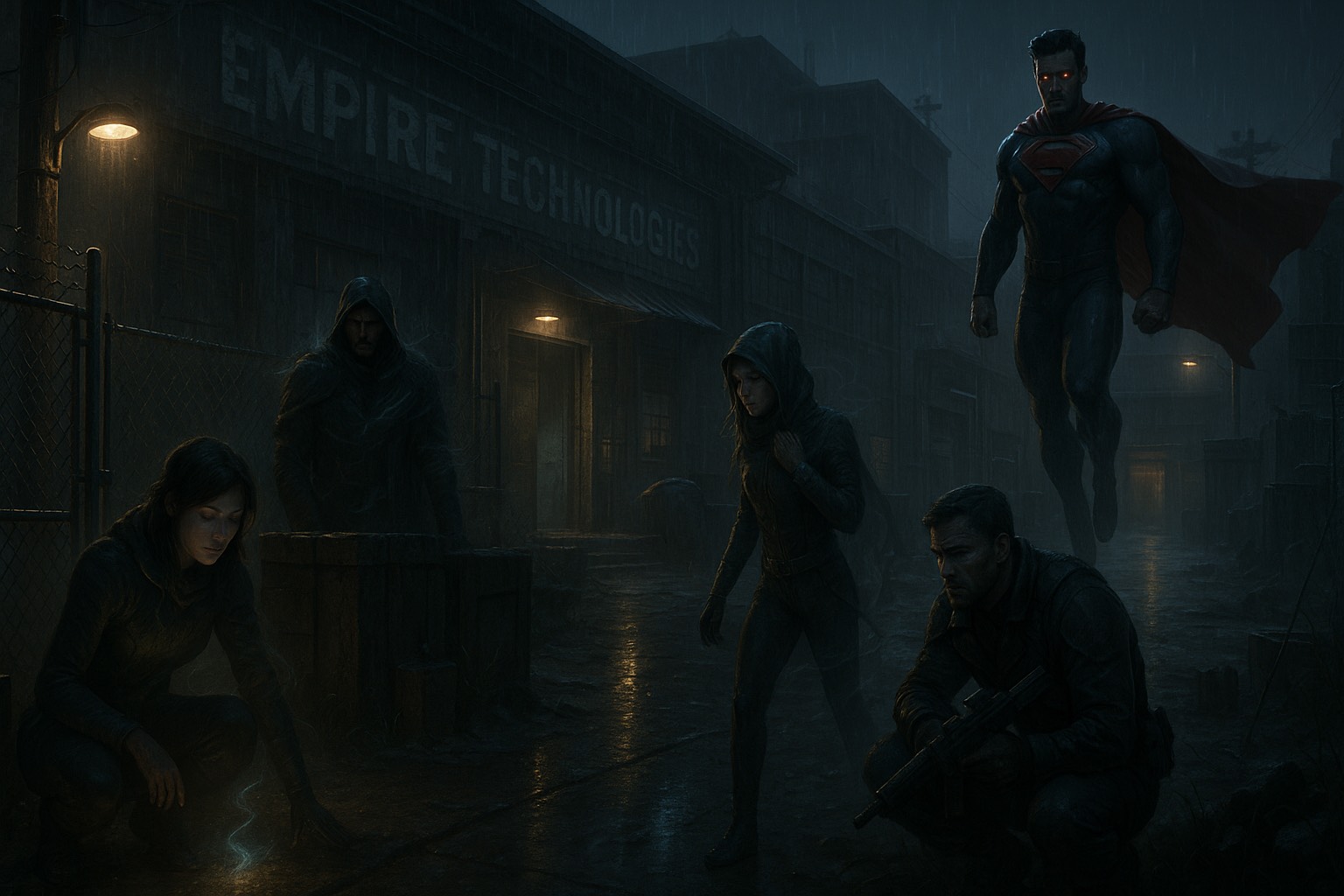
Rain came down steady over Metro City's industrial outskirts, drawing pale lines through the sodium glow of a lamp that had survived whatever else out here hadn't. The Vanguard waited behind a stack of shipping crates near a checkpoint nobody had staffed in years. Across the fenced yard sat the old Empire Technologies research block: dark windows, corrosion bleeding down the signage, a hum somewhere inside that meant something was still drawing power. They had come for two things. Something on why the meteor fragments seemed to be losing their charge, and, if they were lucky, something on why nullifiers slid off Alex like water off a coated pan.
Mira closed her eyes and let the building come to her first, the way she always did before her feet did. Old fear, baked into the walls rather than moving through them. Nothing awake. She opened her eyes and found Elena already watching her, waiting for the read.
"Nothing active," Mira said. "But this place has been afraid of something for a long time."
Striker crouched at the chain-link, running his eyes along the fence line, the dead cameras, the grass grown up through the tarmac in a pattern too even to be neglect. His gift never gave him words, only weather: a pressure at the back of the skull that meant something was coming before he had any way to know what. It was pressing on him now. "Too quiet for a Sovereign asset," he said. "I don't like walking into quiet."
Elena crossed to the lock, clipped a small device to it, and sent a pulse down the line. It clicked open on the first try. She waited for an alarm that didn't come. "That was almost insulting," she murmured, and eased the gate wide enough for them to slip through.
They crossed the yard in the rain, Li Chen bending the light around them into something the eye slid off rather than caught, careful and thin, nothing that would show up as a heat bloom or a shimmer to anything automated. A side door gave to Elena's second bypass as easily as the first had. Too easily, Striker thought again, and said nothing this time, filing the thought the way he'd learned to file most of them lately: not discarded, just held.
Inside, the air was thick with old coolant and standing damp. Emergency strip lighting ran along the skirting, amber and undimmed after however many years this place had sat empty, which was its own kind of wrong; abandoned buildings lost their power long before they lost their dust. Dust there was none of, either, not on the strip lights, not on the handrail Alex's fingers brushed as they moved down the corridor. Someone had been keeping this place ready.
They found a data room off the first junction, its terminal lit and unlocked, a courtesy nobody had asked for. Elena sat and started pulling files while the others fanned out to cover the door. "Partial logs," she said, low. "Fragment research. Solar radiation cross-references. This might be it."
Alex stood in the doorway, arms folded, watching the empty corridor behind them rather than the screen. "Nobody left a facility like this open by accident."
"Maybe they didn't expect anyone left alive who'd know to look," Marcus said, though he didn't sound like he believed it.
Li Chen's illusion around the doorway flickered, a fractional loss of concentration she covered by tightening her jaw. "It feels built," she said. "Like the fear in here isn't left over. Like someone set it and walked away."
Mira felt it too, now that Li Chen had put a shape to it: not residue but staging, a room dressed to look abandoned by someone who'd thought carefully about what abandoned should look like. "Elena. Whatever you're going to take, take it fast."
Elena found the file a moment later: FRAGMENT ENERGY DIVERGENCE. Inside it, references to a test subject whose cells metabolised the meteor's radiation differently from every other recorded case, cross-indexed against solar exposure logs that looked, at a glance, like nothing so much as a feeding schedule. Her pulse climbed. This was Alex, or close enough to him that the distance didn't matter. She reached for the copy command.
The screen went black in her hands.
A groan of old machinery rolled down the corridor and the amber strip lighting flipped to red. Li Chen's illusion came apart at the seams, torn loose by the shock of it, and for a moment they stood in plain sight of whatever was coming. Striker was already moving, a hand up for quiet that nobody needed telling twice.
From a side passage, something whirred and found them: a turret, low on its mount, the red thread of a targeting laser walking across the floor toward Elena's boots.
"Down," Striker said, and had her behind the console before the word finished, sparks raking the far wall where she'd been standing. Li Chen threw up another illusion, half-formed and shaking under the strain, enough to make the corridor read as empty for one crucial second. Marcus found the turret's air intake with a thread of wind no wider than a finger and pushed, just enough to walk its next shot two feet wide. Mira held the fear in the room from tipping over into panic, one hand pressed flat to the wall like she could feel the building's pulse through it and slow it by will alone.
Alex didn't want to put a fist through it. A locked-down facility with a rigged turret might have worse waiting behind a second trip-wire, and a punch was a signature, loud and traceable. He narrowed his eyes instead, a short controlled burst of heat finding the turret's sensor cluster and cooking it blind rather than blowing it apart. The red thread died. The whirring wound down to nothing.
They found a second terminal in the office next door, half-hidden behind a filing cabinet someone had shoved in front of it a very long time ago, or wanted it to look that way. Elena worked faster this time, sweat cutting a line down her temple, and pulled a fragment of the file before the connection failed again: references to "Subject A," and to something called the Solar Integration Protocol. Not the whole picture. Enough of one corner of it to see the shape of the rest. Meteor-derived energy, the file suggested, didn't simply sit in a body the way it had settled into every other survivor's. In Subject A it kept drawing on an outside source, sunlight, the way a battery kept trickle-charging off a socket nobody had unplugged. It would explain the hospital window that had healed him faster than the doctors could account for, the strength that returned to him every dawn like a debt being paid on schedule. It would explain, maybe, why a device built to choke off stored power found nothing in him to choke off, because he was never only running on what he'd stored.
There was more, buried in a footnote she almost scrolled past: a modelling run, theoretical, never repeated in the file's own history. Whatever let a body draw on sunlight instead of simply storing a dose wasn't a switch anyone could throw on purpose. It had to already be there, dormant, in vanishingly few people, and in every simulation the file's authors had run, a sudden full exposure to that much raw solar-charged energy tore the pathway open faster than the cells could follow. Not adaptation. Rupture. The only surviving case in the model was one where the exposure came slow and shielded — buried first, kept from direct light for days afterward, the change arriving in doses too small to break anything, until the body had already decided what it was going to become before it ever had to prove it could survive becoming it.
Elena read it twice before she said anything. "The rubble. The hospital window they kept you behind for weeks before anyone let real sunlight near you." She looked up. "That wasn't recovery time. That was the only reason you're alive."
Alex didn't answer straight away. He'd spent four months underground with a piece of that meteor already answering something in him, and he'd never once thought of it as protection. "So if it had hit me out in the open. No rubble, no hospital."
"Then you'd be a different chapter in someone else's file," Elena said quietly. "Not standing here reading this one."
"Got it," she said after a moment, breathing hard, and pocketed the drive. "Not all of it. But it's real. It's not a rumour."
They pulled back through the corridor at a jog, Li Chen's illusion patchy but sufficient, Marcus clearing their path of anything that might catch underfoot with short controlled gusts, Striker walking backward through the last stretch with his eyes on the dark behind them until the door shut on it. Outside, the rain had not let up. It ran down the back of Elena's collar as she stopped at the fence and let herself, finally, be out of breath.
"Someone wanted us to find this," Alex said. Not a question.
"Someone wanted us to find some of it," Elena said. "The easy part. Enough to keep us digging in the right direction, maybe. Or the wrong one."
Striker looked back once at the dark building, at the too-clean dust line along the fence they'd cut. "Next time something looks easy," he said, "remind me I said that."
They walked back into the city with the rain washing the last of the facility's chemical smell off their coats, Elena's drive a small hard weight in her pocket that felt, she thought, heavier than its size had any right to.
In the control room, Nyx watched them go on a feed two seconds behind real time, the drive already logged as taken the instant Elena's fingers closed around it.
"They got the footnote," she said. "Not the appendix."
"Which was the point." Sovereign watched the same grainy exit through the fence, hands folded. "Let them believe they stole something. It keeps them from asking who left the door unlocked."
"And when they work out the rest of it themselves?"
"Then they'll have earned it the hard way, same as everyone does eventually." Sovereign's attention didn't move from the screen. "Reseed the facility. Something new for the next time they come looking. Nothing that matters."
Nyx was already keying the request through, three systems deep before Sovereign finished the sentence. It was, she'd found, usually faster to anticipate the order than wait to be told.